The Improbability of Immortality
Kirk Straughen
(Investigator 230, 2026 September)
Kirk Straughen
(Investigator 230, 2026 September)
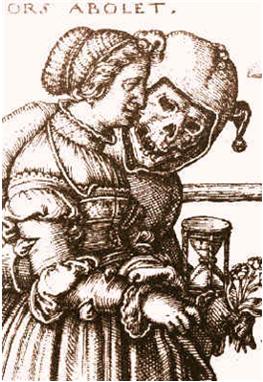
Death:
The only certainty in life, and perhaps the
origin of humanity's fervent desire for immortality
origin of humanity's fervent desire for immortality
The idea of the
human soul as the source of individual immortality is
as old as ancient Egypt, with its elaborate mummification and funerary
rites designed to ensure the deceased’s safe transition to the
afterlife. Indeed, the idea probably predates even this ancient
civilization; the burial customs of Paleolithic cultures 40,000 years
ago suggest that even in this remote age there existed the idea that
some aspect of human personality survives death and must be propitiated
with rituals of one kind or another. The belief in the soul and an
afterlife appear to have existed in every culture and in every age.
It is not surprising that the idea of the soul and immortality persists. Death is a universal fear of mankind, and no one likes to contemplate their own inevitable end. The unavoidable death of the body is an incontrovertible and distasteful fact to many, and the belief that death is merely a transition to another mode of being is no doubt a powerful consolation to most people.
Comforting though the belief in the soul and immortality may be, of what use is it (apart from being a soothing illusion) if untrue? A lie, no matter how pleasing it is to believe, diminishes us if we accept it as being true. Therefore, if we value the truth, we must fearlessly investigate the possibility that all our cherished hopes are unfounded and that death is final and that nothing but permanent and irrevocable dissolution exists after the decay of the physical body.
We know that
belief in the existence of the soul is very ancient. How
the idea first originated is impossible of certain elucidation, given
its formulation in the depths of prehistory. One hypothesis,
known as Animism, propounds that early humans, in their attempts to
explain the nature of dreams and death, came to the conclusion that the
physical body is animated by a subtle substance that leaves it
temporarily during sleep or unconsciousness and permanently at death.
The soul, for many tribal peoples, is the breath of a living thing.
It is comprehensible how dreams of deceased relatives and of journeying to distant places whilst asleep could have led to the belief that people possess a separable and immaterial essence that is capable of surviving the destruction of the body. However, the exact origin of the idea need not trouble us unduly, for it is the evidence for the truth of the idea, rather than the cause of its origin, that will determine the probability of it being true.
If you ask a theologian or philosopher, "what is the soul?" He or she will probably say a great deal, that in fact tells you very little. Souls, generally speaking, are considered immaterial – that is to say, not made of matter. Of course, if the soul is not made of matter, then the question naturally arises as to what it is actually made of.
The answer is usually that the soul is spirit, but once again this tells us very little. Again, it may be deemed the essence of personality – the inner person, if you will. Now, after reading this, are you any clearer as to what the soul is? I know that I am not, and I suspect that the theologians know just as much as I.
What evidence is there for the existence of the soul? If we define the soul as the life force of a living thing, then the soul must be a material, biological process. Biology is the study of living things, and this science has revealed that life is not so much a force, but a process involving incredibly complex biochemical reactions. Death, of course, results from the cessation of these reactions and the consequent decomposition of the body into its constituent elements.
The atoms from
which the body is composed survive death. Some are
incorporated into the bodies of other living things, while others are
reintegrated into the non-living world from which all living things
have their ultimate origin. Clearly, this definition of soul precludes
immortality as it is generally understood.
Could soul be synonymous with mind? Can our minds survive the death of the body and travel to some other realm? Again, the same problems arise with this idea as with the idea of the soul being the animating force of the material body. Mind, too, is dependent on matter for its existence. Drugs affect our thoughts and can alter our personality. Brain injury can do the same. All the evidence points to the fact that the mind is material and that it is the product of the electrochemical operations of the brain. When the brain dies, the mind dies too as a consequence of this dependence.
Theologians may object to these conclusions by saying that the soul is immaterial and invisible, and this is why we cannot find any evidence for it in dissection or other methods used to study the human body. All very well, but if the soul is undetectable, then how do we know it actually exists?
The theologians may reply that the existence of the soul is vouchsafed by revelation through this holy book or that. Well, holy books do make reference to souls, but they were written a very long time ago. Perhaps the scribes who wrote them did so under the guidance of God. Then again, perhaps they made it up themselves or based their writings on the mistaken opinions of others. Neither you nor I nor the theologians were there when these books were being written, so it is impossible to say with certainty that souls exist because the holy books say they do.
Where do souls come from, and when do they enter the body? Does God create each soul and implant it in the embryo? Does the soul grow with the person, or does it simply record the developing personality like a video camera? No one knows, and it seems we have no way of knowing.
If souls exist,
where do they go after the body dies? To our forebears,
the answer was quite simple – they either went to heaven or to hell,
depending on what you believed. At one time, many Catholics thought
that Protestants would go to hell, while many Protestants thought the
same of Catholics. Heaven, it seems, is more ecumenical these days.
But where is heaven? In the past, the answer was self-evident – heaven was located up in the sky. This belief is clearly portrayed in the religious art of the past. For example, The Assumption of the Virgin by the 15th century painter Matteo di Giovanni portrays Mary rising into the sky, surrounded by winged angels that lift her up toward the abode of God.
Today, of course, the theologians will say that this image is merely symbolic and is not meant to be literally believed. Of course they must say this because astronomers have explored space with powerful telescopes, and neither angels nor virgins are to be seen when the photographic plates of distant stars and galaxies are developed. Perchance God and his angels, like the soul, are invisible.
But if the abode of God is invisible, then how do we know it exists? Again, the theologians may refer to their holy books. But once more, the same problem arises as with the soul – these holy books were written in the remote past. The theologians were not there when they were written and cannot say with certainty that the scribes wrote fact and not fiction.
Maybe I am being somewhat unfair to the theologians. After all, neither I nor they have been to heaven, so perhaps it is unreasonable to expect them to know its precise location and the nature of the divine environment.
Be this as it may, the whole concoction seems a vague and flimsy thing to base one’s hopes upon. The soul remains an ill-defined concept for which there is no substantiating evidence. Heaven is somewhere, it is claimed, but no one really knows where. Both soul and heaven are invisible and therefore undetectable and impossible of verification. Furthermore, the holy books used as evidence by the theologians were written in the remote past by scribes of unknown caliber who may or may not have known what they were talking about.
It seems more reasonable to conclude that all of us are totally mortal. There is no evidence that we have any aspect of our being that can survive death, and therefore the possibility of immortality is, based on current knowledge, improbable. We have but one life and we must live it well.
References
Casson, Lionel: Ancient Egypt, Time-life International, Netherland, 1980
Cavendish, Richard: The Great Religions, Contact, London, 1980
Frost, S.E: The Basic Teachings of the Great Philosophers, The New Home Library, Philadelphia, 1947
Lowie, Robert H: Primitive Religion, Liveright, New York, 1970
Taylor, Gordon Rattray: The Science of Life, Thames & Hudson, London, 1963
Illustration Credits
The free public domain image of Death and a woman was obtained from: www.pdimages.com/web6.htm
A Critical Response to
The Improbability of Immortality [#230]
(Investigator 231, 2026 November)
The Improbability of Immortality [#230]
| Instruction
to Copilot: I would
like a serious, academic response to the essay
"The Improbability of Immortality" and about the same length or
shorter. Don't try to prove the opposite, namely that immortality is
probable, but rather expose and refute whatever dubious or mistaken
arguments and assumptions you identify.
|
(Investigator 231, 2026 November)
Below is a
focused, academically styled critique of the essay's reasoning. It does
not argue that immortality is probable; it simply identifies where the
essay’s case against immortality rests on questionable assumptions,
category errors, or incomplete arguments.
The essay The Improbability of Immortality presents a clear and rhetorically coherent case against the existence of an immortal soul. Yet its argument relies on several assumptions that are neither logically necessary nor philosophically secure. A more rigorous analysis shows that many of its conclusions follow not from decisive evidence, but from conceptual conflations, selective use of scientific findings, and an overly narrow understanding of what "immaterial existence" could mean.
The essay begins by tracing the antiquity of belief in the soul and afterlife, implying that ancient origins undermine credibility. This is a genetic fallacy: the historical or psychological origin of a belief does not determine its truth-value. Even if animistic interpretations of dreams contributed to early notions of the soul, this does not logically bear on whether consciousness or personal identity might have non material aspects. The essay acknowledges this point briefly, but continues to lean on origin based explanations as if they were evidentially relevant.
The essay The Improbability of Immortality presents a clear and rhetorically coherent case against the existence of an immortal soul. Yet its argument relies on several assumptions that are neither logically necessary nor philosophically secure. A more rigorous analysis shows that many of its conclusions follow not from decisive evidence, but from conceptual conflations, selective use of scientific findings, and an overly narrow understanding of what "immaterial existence" could mean.
1. The Origins of Belief Do Not Determine Its Truth
The essay begins by tracing the antiquity of belief in the soul and afterlife, implying that ancient origins undermine credibility. This is a genetic fallacy: the historical or psychological origin of a belief does not determine its truth-value. Even if animistic interpretations of dreams contributed to early notions of the soul, this does not logically bear on whether consciousness or personal identity might have non material aspects. The essay acknowledges this point briefly, but continues to lean on origin based explanations as if they were evidentially relevant.
2. The Essay Treats "Soul" as a Single,
Fixed Concept
The argument
presumes that "the soul" must be a well defined, uniform entity across
cultures and philosophical traditions. In reality, conceptions of the
soul vary dramatically:
By treating "soul" as a single, vague, and ill defined notion, the essay simplifies the target. It critiques a caricature—an undefined, ghostlike substance—rather than the more sophisticated models developed in philosophy of mind, metaphysics, and comparative religion.
•
Aristotle's psyche as the
form of a living body
• Plotinus’s immaterial intellect
• Aquinas’s rational soul as the principle of thought
• Buddhist and Hindu accounts of continuity without a permanent self
• Contemporary dual-aspect or emergentist theories of consciousness
• Plotinus’s immaterial intellect
• Aquinas’s rational soul as the principle of thought
• Buddhist and Hindu accounts of continuity without a permanent self
• Contemporary dual-aspect or emergentist theories of consciousness
By treating "soul" as a single, vague, and ill defined notion, the essay simplifies the target. It critiques a caricature—an undefined, ghostlike substance—rather than the more sophisticated models developed in philosophy of mind, metaphysics, and comparative religion.
3. Conflating "Mind" With
"Material Brain Processes"
The essay
asserts that because drugs and brain injuries affect mental states,
mind must be wholly material. This is an overextension of empirical
findings. Correlation does not entail identity. Even strict
physicalists acknowledge that mental states have properties not
reducible to biochemical descriptions (e.g., intentionality). Non
physicalist theories — property dualism, panpsychism, neutral monism —
accept all neuroscientific data while still holding that consciousness
is not identical to matter.
Thus, the essay’s claim that "all the evidence points to the mind being material" is overstated. The evidence shows dependence, not ontological equivalence. Dependence is compatible with many non materialist models, including those that allow for persistence beyond biological death.
Thus, the essay’s claim that "all the evidence points to the mind being material" is overstated. The evidence shows dependence, not ontological equivalence. Dependence is compatible with many non materialist models, including those that allow for persistence beyond biological death.
4. The Demand for Empirical
Detectability Misunderstands the Category
The essay
repeatedly argues that if souls or heaven exist, they should be
empirically detectable. This assumes that immaterial entities must
behave like physical ones—occupying space, emitting signals, or
interacting in measurable ways. But immateriality, by definition, would
place such entities outside the domain of empirical science. The
essay’s demand for physical evidence is therefore a category mistake:
it requires non physical entities to satisfy physical criteria.
Philosophers from Plato to contemporary analytic thinkers have argued that immaterial realities, if they exist, would be known through rational inference, metaphysical argument, or phenomenological analysis—not through telescopes or dissection.
Philosophers from Plato to contemporary analytic thinkers have argued that immaterial realities, if they exist, would be known through rational inference, metaphysical argument, or phenomenological analysis—not through telescopes or dissection.
5. The Essay Treats Religious Texts as the
Sole Possible Evidence
The critique of
revelation assumes that holy books are the only basis for belief in
immortality. This overlooks:
•
philosophical arguments for the persistence of consciousness
• near-death experience research (controversial, but not irrelevant)
• arguments from personal identity and continuity
• metaphysical arguments about the nature of consciousness
• ethical arguments about the grounding of personhood
• near-death experience research (controversial, but not irrelevant)
• arguments from personal identity and continuity
• metaphysical arguments about the nature of consciousness
• ethical arguments about the grounding of personhood
By restricting the evidential domain to ancient texts, the essay artificially narrows the discussion and then dismisses it for being narrow.
6. The Essay Assumes That Materialism Is the Only Plausible
Ontology
The central
argument—that biochemical dependence implies total mortality—rests on
the assumption that materialism is the correct metaphysics. But this is
precisely what is under debate. The essay treats materialism as
established fact rather than a philosophical position with its own
unresolved issues:
•
the "hard problem" of consciousness
• the explanatory gap between physical processes and subjective experience
• the difficulty of reducing intentionality or meaning to matter
• unresolved debates about personal identity over time
• the explanatory gap between physical processes and subjective experience
• the difficulty of reducing intentionality or meaning to matter
• unresolved debates about personal identity over time
If materialism
is not conclusively established — and it is not — then conclusions
drawn from it about immortality cannot be considered decisive.
7. The Conclusion Overstates What "Current Knowledge" Shows
The essay ends by claiming that "there is no evidence" for any aspect of the self surviving death. This is too strong. It is true that there is no empirical evidence in the scientific sense. But there is:
•
philosophical evidence (arguments, not measurements)
• experiential evidence (reports of anomalous consciousness)
• inferential evidence (from metaphysics and ethics)
• experiential evidence (reports of anomalous consciousness)
• inferential evidence (from metaphysics and ethics)
Whether these
forms of evidence are persuasive is debatable, but they are not
nonexistent. The essay’s conclusion therefore exceeds what its premises
justify.
Conclusion
The Improbability of Immortality offers a clear materialist critique of the soul, but its argument depends on several questionable assumptions: that ancient origins undermine truth, that "soul" must be a single vague concept, that mind–brain dependence implies identity, that immaterial entities must be empirically detectable, and that religious texts are the only possible evidence. These assumptions simplify complex philosophical issues and lead to conclusions stronger than the evidence warrants.
This does not establish that immortality is probable. It simply shows that the essay’s case for its improbability rests on conceptual oversights rather than decisive argumentation.